
What to Do, When to Do It, & More Tips From Austin Experts
Short Article Recap:
- Mulching leaves means running the mower over them to shred them in place
- This is faster than raking, better for your soil, and cuts down on yard waste
- It works well for light to moderate leaf coverage on established grass, but stops working when layers get too thick, leaves are diseased, or your lawn has a history of fungal problems
- Shredded leaves feed soil biology, suppress weed germination, and reduce how much fertilizer your lawn needs
- Mulching a manageable layer once or twice a week through peak fall season is more effective than trying to process a month’s worth of leaves in a single pass
- Central Texas fall conditions make most yards good candidates for mulching through much of the season
- Get in touch with the lawn care experts at Real Green for a beautiful yard season after season
Mulching Leaves: What Is It?
Mulching leaves doesn’t require special equipment, a separate trip around the yard, or much extra time. You’re running your mower over leaves and letting the blade chop them into small fragments that fall back onto the lawn. That’s the whole process.
A standard mower with a sharp blade handles the job adequately. A dedicated mulching blade does it even more efficiently.
What matters more than equipment is timing and frequency. Chopping a light layer of leaves into small fragments takes one pass. Trying to process a deep, compacted layer takes multiple passes, strains the mower, and often still leaves behind clumps that do more harm than good.
Mulching processes the material on-site and puts it back to work in the soil. For most Central Texas lawns through the fall, it’s the more practical and more agronomically sound than raking and bagging.
Not sure what mulch is? We’ve got you covered.
What Happens to Mulched Leaves?
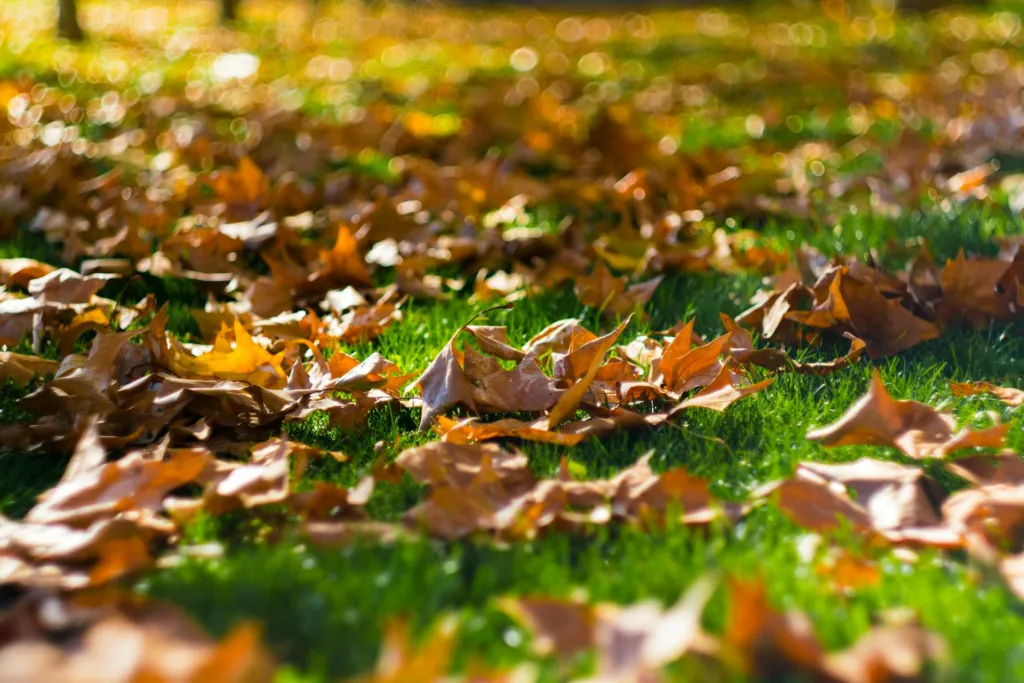
The visual result of a mulching pass is a thin scattering of leaf fragments across the turf surface. Those fragments become active inputs into the soil ecosystem within a relatively short period.
As the material breaks down, it releases nitrogen, phosphorus, and potassium back into the root zone. Over a full season of consistent mulching, the contribution is meaningful enough to reduce how much supplemental fertilizer an established lawn actually needs.
The biology matters here too. Earthworms, soil fungi, and microbial populations all feed on decomposing organic material.
As those populations grow and work through the leaf fragments, they improve soil structure. Lawns with active soil biology drain better, hold moisture more efficiently, and develop deeper, more resilient root systems than lawns managed on chemistry alone.
There’s also a weed suppression effect. A thin layer of decomposing leaf material at the soil surface reduces light exposure to weed seeds that need it to germinate. It won’t eliminate weed pressure on its own, but it’s a passive contribution to suppression that complements other weed control strategies.
On the environmental side, yard waste that gets bagged and landfilled breaks down anaerobically, producing methane. Organic material that decomposes on-site doesn’t produce that methane and keeps nutrients out of storm drains and waterways.
When Mulching Does & Doesn’t Make Sense
This is the part most mulching guides skip over, and it matters as much as the benefits.
Mulching Works Well When:
Leaf coverage is light to moderate. After you make a pass with the mower, you should still be able to see roughly half the grass beneath the shredded fragments. If the lawn surface is still mostly obscured after mulching, the layer is too heavy to process effectively in a single session.
Your grass is well established. An established lawn with a developed root system and a closed canopy handles the addition of leaf material without difficulty. New sod or a recently seeded area needs light and airflow during establishment.
The leaves are dry. Wet leaves don’t shred cleanly. They clump, stick together, mat against the soil surface, and clog the mower deck.
You can mulch consistently through the season. A yard where leaves fall gradually and the mower goes over them weekly stays manageable.
When to Rake, Bag, or Compost Instead:
The layer is simply too heavy. Four to six inches of loose leaves is roughly the upper limit of what a mower can process into a useful result. Beyond that, the shredded material accumulates faster than it decomposes, creating a mat that blocks light and traps moisture against the soil.
The leaves show signs of disease. Fungal infections, leaf spot, or other visible disease on fallen leaves can persist in decomposing material at the soil surface. If the source tree has had disease problems, removing the leaves is safer than cycling the pathogens back into the lawn.
The property is near a waterway. If your yard drains toward a creek, pond, or lake, keeping leaf material away from the drainage path matters. Even beneficial nutrients cause problems in water bodies.
Your yard has a history of fungal disease. Thick organic material sitting against the soil surface through winter creates favorable conditions for fungal pathogens. Clearing leaves thoroughly before the first hard frost is worth the extra effort.
What Austin’s Conditions Mean for Fall Mulching
Central Texas falls are generally favorable for mulching, with a few site-specific factors worth knowing.
Soil temperatures in the Austin area stay warm enough through most of October and into November to support active soil biology.
The dominant trees dropping leaves across Central Texas (live oaks, cedar elms, pecans, Texas red oaks) produce leaf material with varying characteristics.
- Live oak leaves are small, leathery, and decompose slowly. In years with a heavy live oak drop, or in yards with several mature trees, it’s common to need multiple mowing passes to process them adequately.
- Pecan leaves are larger and break down more readily. Knowing what you’re working with helps set realistic expectations for how much material a single mowing session can handle.
Six Steps for a Clean Mulching Pass
You don’t need a specialized mower or technique. A few good habits make a big difference.
- Choose the right conditions. Dry leaves on dry grass, ideally on a calm afternoon. If there was rain in the last day or two and the leaves are still clumped and wet, wait.
- Set your mower at your normal fall cutting height. There’s no need to lower the blade for leaf mulching. Standard fall mowing height is correct: typically 3 to 4 inches for most Central Texas warm-season grasses.
- Remove or close the collection bag. The goal is to return the chopped material to the lawn surface, not collect it.
- Move at a deliberate, moderate pace. Moving too quickly reduces the number of times the blade contacts the material. Slowing down by roughly 25 to 30 percent from your normal mowing pace gives the blade time to shred leaves into smaller fragments.
- Assess the result and make a second pass if needed. After the first pass, check whether the fragments are small enough (roughly dime-sized or smaller). If not, make a second pass at a 90-degree angle to the first.
- Know when the situation calls for raking instead. If the lawn still looks smothered after two passes, stop. Continuing to run the mower over heavy leaf material compacts it rather than shredding it. Rake the excess into a garden bed or compost pile and address what’s left.
Staying Ahead of Peak Season
The most common mulching mistake is timing. Letting leaves accumulate for two or three weeks and then trying to process the entire volume in one session creates the kind of heavy, smothered result that mulching is supposed to avoid.
During peak leaf drop in October and November, a once-or-twice-weekly mulching pass keeps the volume manageable.
By late fall, when temperatures drop and trees have dropped most of their canopy, it’s worth doing a thorough assessment of the lawn surface. Any significant leaf accumulation left in place through the coldest months can mat against the soil and delay spring green-up. Clearing or composting what remains before the first hard frost eliminates that risk.
Troubleshooting
The lawn looks patchy or mat-like after mulching. Too much material in a single session. Rake up the thicker accumulations, spread out future mulching sessions, and consider mulching at a slightly higher blade setting.
Clumping and mower clogging mid-session. Either the leaves are too wet, the layer is too deep, or both. Stop and let conditions dry out if moisture is the issue.
Visible mat of organic material still present after multiple passes. The leaf variety may be the problem. Small, waxy leaves like live oaks shred less efficiently than larger, thinner leaves. Going over the area one additional time at a different angle usually resolves it, or rake the remainder into beds as mulch.
Frequently Asked Leaf Mulching Questions
There’s Mulch to Do This Fall
Mulching is one piece of a seasonal lawn care approach that keeps Central Texas yards healthy through fall, dormant through winter, and ready to perform when spring arrives. If you want the rest of that approach managed professionally, Real Green handles lawn care across Austin and the surrounding communities:
- Austin
- Buda
- Cedar Park
- Coupland
- Del Valle
- Driftwood
- Dripping Springs
- Florence
- Georgetown
- Granger
- Hutto
- Jarrell
- Kyle
- Leander
- Liberty Hill
- Manchaca
- Manor
- Pflugerville
- Round Rock
- Schwertner
- Spicewood
- Taylor
- Thrall
- Walburg
- Weir
- Brushy Creek
- Jollyville
- Anderson Mill
- Wells Branch
- Shady Hollow
- Hornsby Bend
- San Leanna
- Rollingwood
- West Lake Hills