
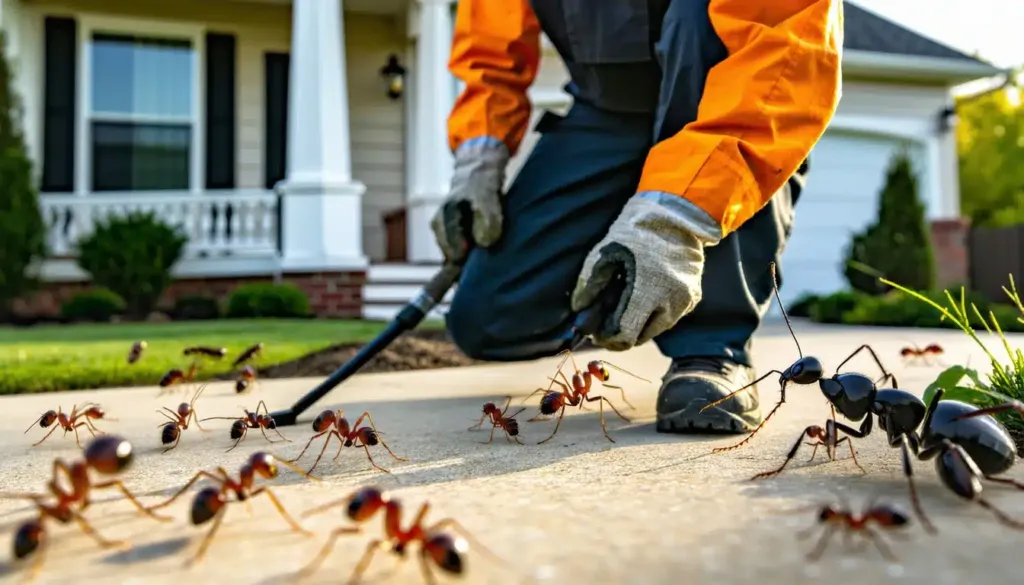
How to ID & Get Rid of Different Types of Ants
Posted on March 17, 2026
Learn About Fire Ants & Other Annoying Texas Pests
Have you seen a fire ant mound in your yard? Or noticed a trail of them marching across the sidewalk? Sadly, crossing your fingers and spraying them won’t 100% work. Because different ant species have unique behaviors, nesting habits, and risk levels.
That’s why the experts at Real Green are sharing how to spot common types of ants, what risks each one actually poses, and the smartest ant control methods you can use in Austin.
What Kind of Ant Is This?
Start trying to ID ants by paying attention to where they’re showing up. A mound on your lawn, a trail running along the edge of your driveway, or activity clustered around a woodpile? This gives a clue about what you’re dealing with.
Size and color matter too. Are they barely visible or really large? Black, red, brown, or yellow? Does the abdomen look heart-shaped or almost wasp-like?
Watch how they move. Tight single-file trails suggest a well-organized species like odorous house ants or Argentine ants. Frantic, zigzagging movement? That might mean you’re looking at crazy ants.
Surprisingly, you can also crush one and take a sniff. A rotten coconut smell, a citrusy note, or no odor at all can point in different directions.
Beyond the ants themselves, look at what’s nearby. Dome-shaped mounds in open, sunny patches of lawn are a classic fire ant signature. Fine wood shavings near a baseboard or windowsill could be carpenter ants. Mud tunneling around damp wood close to a plumbing leak often is moisture ants.
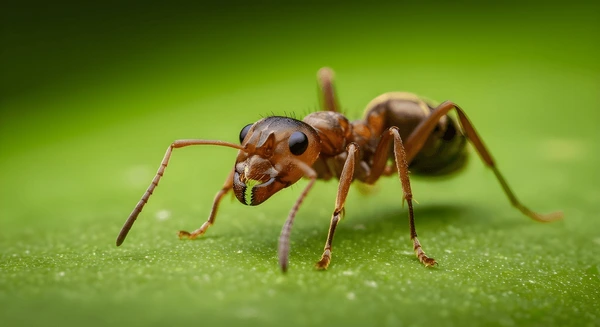
Details About Different Types of Ants
Thousands of ant species exist across North America, and a handful show up in Texas homes and yards. Here’s a breakdown of the ones most likely to give you trouble.
Fire Ants
- Appearance: Workers vary in size within the same colony. Look for the distinctive raised, dome-shaped mound with no visible openings on top. Commonly found in lawns and along roadsides throughout Austin.
- Risk: Fire ants sting repeatedly, injecting alkaloid venom that causes a burning sensation and raised welts. A single colony can hold up to 250,000 workers, and for anyone with an allergy, a mass attack is a genuine medical emergency.
- Control: Spread granular bait across the full treatment zone rather than applying it directly to the mound.
Leafcutter Ant (Texas Leaf Cutter)
- Appearance: Reddish-brown workers in a broad size range (1/16 to 1/2 inch) that march in columns carrying cut leaf fragments. The leaves aren’t food, but they grow the fungus that actually feeds the colony.
- Habitat & range: Concentrated in East Texas, the Rio Grande Valley, and Louisiana. Well-established colonies can spread across an entire acre.
- Risk: A serious plant pest, particularly for pine seedlings during winter months when other vegetation is sparse.
Twig Ant
- Appearance: Long and lean, often patterned in orange and black, with notably large eyes that give them an almost wasp-like profile.
- Habitat & range: Tree-dwelling by nature, nesting inside hollow branches and twigs. Common throughout Texas, Florida, and the broader South.
- Risk: Provoke one and it will sting, so be careful when working around shrubs and trees in southern yards.
Sugar Ant
- Appearance: An umbrella term covering several small (2–15 mm) species in brown, black, or reddish tones that show up wherever sweets are accessible. Usually pavement ants, Argentine ants, or pharaoh ants.
- Habitat: Primarily night-active foragers that squeeze in through any gap around a door, window, or pipe in search of sugary food.
- Control: Start with sanitation and exclusion. Bait placed along established trails will always outperform a spray.
Pavement Ant
- Appearance: Dark brown to nearly black, around 1/8 inch. They’re distributed across the entire U.S.
- Habitat: Build nests beneath stones, in cracks along pavement, and tight against building foundations.
- Control: Address standing water, fill in foundation cracks, pull vegetation back from the house, and relocate firewood away from the structure.
Thief Ant / Grease Ant
- Appearance: One of the tiniest household species at just 1.5–2.2 mm, ranging from pale yellow to light brown.
- Habitat & risk: Drawn to high-fat, high-protein foods rather than sweets. They nest in tight crevices and use wall voids as travel corridors.
- Control: Widely distributed across the U.S. Protein- or grease-based bait works significantly better than sugar bait for this species.
Acrobat Ant
- Appearance: Light to dark brownish-black, roughly 1/8 inch, with a heart-shaped abdomen they tilt upward when feeling threatened.
- Habitat & range: Found from coast to coast. They prefer to nest in moist or water-damaged wood.
- Control: Acrobat ant infestations almost always trace back to a moisture issue. Address the source of the water damage first, and the ant problem typically resolves with it.
Crazy Ant (Caribbean Crazy Ant)
- Appearance: About 1/8 inch, with a coat of reddish-brown hairs and a distinctive erratic movement pattern. They scatter in all directions rather than forming organized trails.
- Habitat & range: Present throughout the U.S., though limited to indoor environments in colder northern states; they tend to push indoors in fall or following heavy rain.
- Control: Multi-queen colony structures make conventional sprays nearly useless. Focus on sealing entry points, keeping vegetation trimmed back, and deploying bait.
Citronella Ant (Yellow Ant)
- Appearance: Workers measure 4–5 mm with yellow-to-amber coloring. Their winged reproductives are larger and commonly confused with termites.
- Habitat: Subterranean nesters that stick to damp areas under concrete slabs, along foundations, and in crawlspaces. However, they’re harmless to structures and humans.
- Control: The late-summer swarms can look alarming, but they wrap up fast and treatment is rarely needed.
Pharaoh Ant
- Appearance: Exceptionally small at 1.5–2 mm, nearly see-through, with coloring that ranges from pale yellow to light reddish-brown.
- Habitat & risk: Favor warm, humid hiding spots. Can harbor and spread pathogens including staph and strep, making them a serious concern anywhere food is handled.
- Control: Conventional sprays trigger “budding,” causing the colony to fracture into multiple new ones. Slow-acting bait and professional ant control are the best options.
Carpenter Ant
- Appearance: Notably large (1/4 to nearly 1 inch), usually black, and active primarily after dark.
- Habitat: They tunnel through wood, excavating galleries in damp or deteriorating wood. Frequently keep satellite colonies inside the home while the primary nest sits in a nearby tree stump or woodpile.
- Control: Sawdust-like frass near wood structures is the key warning sign. Apply perimeter and non-repellent treatments, and put real effort into locating and treating the main nest.
Little Black Ant / Black Garden Ant
- Appearance: Tiny (around 1/16 inch), solid black, with a two-node waist and no spines on the thorax.
- Habitat: Nest outdoors under rocks, in decaying logs, and beneath stacked lumber. Indoors, they gravitate toward woodwork, wall voids, and masonry.
- Control: More annoyance than actual threat. Caulk exterior gaps, store firewood at least 20 feet from the house, and keep foundation plantings trimmed back.
Ghost Ant
- Appearance: Tiny at 1.5 mm, with translucent legs and abdomen. Crush one and it releases a faint coconut scent.
- Habitat: Primarily a warm-climate pest, especially prevalent in Florida. Drawn to sweets and attempts to enter through small gaps or hitch rides indoors on houseplants.
- Control: Multiple queens and distributed nesting sites make self-treatment unreliable. Professional baiting strategies are often necessary.
Moisture Ant
- Appearance: Around 1/8 inch, yellowish to dark brown, with a translucent abdomen that can look almost wet.
- Habitat: Nest strictly in rotting or water-compromised wood. Build mud channels between wood and soil.
- Control: Treat moisture ants as a symptom. Until you correct the underlying moisture problem, no ant treatment will provide lasting results.
Odorous House Ant
- Appearance: Small (1/16–1/8 inch), brown-to-black. They have a rotten coconut smell when crushed.
- Habitat: Among the most common indoor ant species in the country. Nest in wall voids, beneath sinks, and in damp soil, and follow relentless trails straight to anything sugary.
- Control: Spraying just pushes the colony to relocate. Methodical baiting along active foraging trails is what actually works.
Army Ant
- Appearance: About 1/4 inch, dark brown to black body with an orange-tinted abdomen and large, forceful mandibles.
- Habitat & range: No permanent nests, just temporary living bivouacs containing millions of individuals. Mainly confined to Florida, Texas, and the Gulf Coast.
- Risk: Not a structural pest, but a raiding column sweeping through your yard is something worth addressing before it becomes an encounter.
Field Ant
- Appearance: Large (4–8 mm), often red, black, or a mix of both. Construct broad, flat mounds spanning 3–4 feet across in open, well-lit areas.
- Habitat & range: A common sight across North American lawns, meadows, and fence rows.
- Risk & control: Bites hurt, and they supplement the pain with a formic acid spray. Treat mounds with a labeled granular or liquid drench product.
Options for Eliminating Ants
The most common mistake homeowners make? Reaching for a spray. Killing the ants you see only scratches the surface. The queen, the brood, and most of the colony are safely underground and will replenish those workers within days. And for certain species (pharaoh ants), spraying can actually make the colony to split, turning one problem into several.
Baits operate on a completely different logic. Workers pick up the slow-acting material and carry it back through the colony, eventually reaching the queen. It takes patience, but the result is far more thorough than any surface spray.
For outdoor mounds and nests, granular bait broadcast across the surrounding area (rather than dumped directly on the mound) is the most effective method for fire ants and carpenter ants. Foundation perimeter treatments using non-repellent products also help block re-entry before it becomes a recurring problem.
Differences by Region & Season
Warm southern regions (the Gulf Coast, Florida, and Texas): Fire ant control in Austin, TX seems to never end, but activity peaks in spring and fall. Army ants and twig ants are also more of a Texas and Gulf Coast issue. Longer warm seasons mean longer activity windows across almost every species.
Cool, damp climates (the Pacific Northwest, New England, the upper Midwest): Carpenter ant and moisture ant activity tends to dominate, driven by the wetter conditions and older housing stock common in those areas.
In general, fall is when ants most commonly push indoors as temperatures drop and outdoor food sources dry up. Colonies that get established near indoor heat sources can also remain active through winter.
Tips for Stopping Ants From Coming Back
Making your Austin home a less inviting target is the most durable form of ant control. Four areas cover most of the ground:
Exclusion. Seal gaps around the foundation, doors, windows, and any utility penetrations with silicone-based caulk. Check weatherstripping and window screens for wear.
Sanitation. Keep food in airtight containers. Wipe up spills and crumbs right away, including under appliances. Use lidded trash cans and empty them consistently.
Moisture control. Fix leaks at the source. Make sure gutters are clear and downspouts direct water away from the foundation.
Yard and landscape. Pull mulch back at least 12 inches from the foundation. Move firewood well away from the house. Trim any branches or shrubs making contact with the exterior walls, and clear out leaf litter where ants like to establish nesting sites.
When to Get an Ant Control Pro?
Some ant situations call for professional help. A few clear signals:
- Stinging species like fire ants or twig ants in areas where kids, pets, or guests spend time
- Large nests, multiple simultaneous colonies, recurring infestations, or commercial properties that are at risk
- Ongoing ant activity even after you’ve correctly applied bait
- Any signs of potential structural damage
A licensed Austin pest control professional can accurately identify the species, track down nests that aren’t visible from the surface, and apply treatments not available over the counter.
Comm Ant FAQs
-
What's the fastest way to get rid of ants?
Bait. It takes longer than spraying, but it targets the whole colony rather than just the scouts you can see.
-
What ants damage wood?
Carpenter ants and moisture ants are the main wood-associated species. Neither one actually eats wood, but both excavate or nest in it.
-
What ants smell like coconut when you crush them?
Odorous house ants and ghost ants both release that characteristic coconut-like odor.
-
Is bait really better than spray?
For most indoor ant problems, yes.
-
What do winged ants mean?
Winged ants (called swarmers or alates) are reproductive individuals leaving an established colony to mate and found new ones. They’re a sign the colony nearby is mature and healthy.
-
How do I find the ant nest?
Follow the trail back toward the source. Ants move in consistent lines between food and nest. Trace the column at night when activity is highest.
-
What are the most common household ants?
Odorous house ants, pavement ants, Argentine ants, and little black ants account for most indoor infestations across the U.S.
-
Why do ants return every season?
Because whatever drew them in hasn’t been eliminated. Treating the symptom without addressing the cause is a reliable recipe for the same problem next year.
Ants Making You Antsy? Call Us!
Getting ahead of different types of ants means understanding what you're dealing with, what's making your property attractive to them, and how to hit the root of the problem. For most homeowners, a combination of correct identification, strategic baiting, solid exclusion, and consistent sanitation handles the majority of ant issues. Need help in your fight against fire ants and other lawn pests? Reach out to Real Green! We proudly serve Austin and the surrounding communities of Central Texas, ensuring high-quality lawn care and pest control services across the area.